
Leaving public school can bring a huge sense of relief for families of students with learning disabilities—but it can also raise a brand-new question: What happens to the IEP now? Your Individual Education Plan may have guided goals, accommodations, services, and instruction at school, but homeschooling gives you the opportunity to create a learning plan built around the child in front of you. So…although your child’s IEP doesn’t follow into the homeschool world, you can create your own homeschool IEP, called an Individual Learning Plan (ILP).
Choosing homeschool curriculum can be exciting—and overwhelming. There are countless reading programs, math curricula, online courses, workbooks, unit studies, and all-in-one programs promising to be just what your child needs. You may have been told by many people that Abeka or The Good and the Beautiful is their favorite curriculum. It’s so easy to get a boxed curriculum or all-in-one program. You may even have tried one of those programs only to find that your student shuts down when trying to do the assignments or takes all day to do a worksheet that should take 15 minutes or less.
But before you start comparing curriculum, there is an important question to answer: Where is your child actually working right now and what goals do we really need to concentrate on?
A learning profile can help you identify your child’s current skill levels, as well as the learning strengths and challenges. You can use a full diagnostic evaluation, give your student a free placement test, or go by your knowledge of what your child can and cannot do. A learning plan can be a flexible, working document for YOU that outlines priority goals. It can have just a few goals or many, very specific goals. Instead of trying to recreate the public-school IEP at home, you can use what you already know about your child—including information from previous evaluations and the IEP—to build a practical, flexible roadmap for your homeschool year.
For children with dyslexia, ADHD, autism, developmental delays, or other learning differences, skill levels may be very different from the grade printed on the front of a textbook. A child might be twelve years old and working close to age level in science and verbal language while needing instruction several levels lower in spelling or written expression.
That’s why creating a learning profile can be one of the most useful things you do before choosing homeschool curriculum.
What Is a Learning Profile?
A learning profile gives you a visual picture of your child’s current strengths and areas of need. The goal isn’t to assign your child a score or compare them with other children. Instead, you’re looking for the pattern.
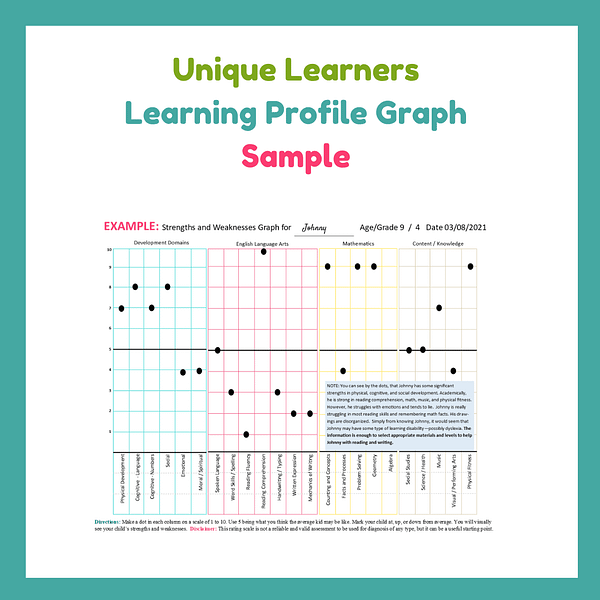
Using a simple chart like the Strengths and Weaknesses Graph shown above, parents can estimate where their child is functioning across developmental and academic areas. You might use a scale from 1–10, with 5 representing approximately what you would expect for the child’s age. Your child’s dots probably won’t form a straight line—and that’s exactly the point.
A student may have advanced knowledge about favorite subjects while struggling with handwriting. Another may be an excellent problem solver but have difficulty memorizing math facts. A child who can carry on a sophisticated conversation may still read several years below grade level. Seeing these differences on paper can make curriculum decisions much easier.
Start With the Five Domains of Development
Before looking only at academics, consider your student’s overall development. Learning doesn’t happen separately from language, physical development, emotions, or relationships.
A helpful learning profile can begin with five broad developmental domains.
1. Physical Development
Physical development includes both gross and fine motor abilities. Think about skills such as balance, coordination, strength, endurance, handwriting, cutting, manipulating small objects, and using school materials.
This matters when choosing homeschool curriculum. A student may understand fourth-grade material but struggle to complete fourth-grade worksheets because handwriting is difficult or tiring. In that situation, the answer may not be easier academic content. It might be fewer written problems, oral responses, typing, manipulatives, or another way to demonstrate understanding.
2. Cognitive Development
Cognitive development involves thinking, reasoning, memory, problem solving, attention, and the ability to understand concepts.
You may notice differences even within this domain. A child might have strong verbal reasoning but weaker working memory. Another might understand mathematical concepts easily but struggle to remember procedures.
Rather than asking only, “What grade is my child in?” ask questions such as:
- Can my child understand new concepts?
- Can they remember information they’ve learned?
- Can they solve problems independently?
- Do they need concrete materials before moving to abstract ideas?
- How much repetition is necessary before a skill becomes automatic?
These observations can help you determine how explicit, repetitive, visual, hands-on, or independent a curriculum needs to be.
3. Language and Communication Development
Language development includes understanding and using spoken and written language.
Consider your child’s receptive language (what they understand) and expressive language (how well they communicate their thoughts). Vocabulary, following directions, explaining ideas, and organizing thoughts all fit here. If your student has a difficult time following directions or communicating with others, you may want to consider a speech-language evaluation.
Language ability can significantly affect academic performance in all subject areas but especially in reading, spelling, and written expression. For example, a student may know how to calculate an answer in math but struggle with word problems because understanding the language of the problem is difficult.
Separating what your child knows from how easily your child can express it gives you a much clearer picture.
4. Social-Emotional Development
Social and emotional development includes interacting with others, understanding social expectations, recognizing and managing emotions, coping with frustration, and developing independence. This domain can have a surprisingly large effect on homeschooling.
A child who becomes overwhelmed easily may do better with short lessons and predictable routines. A student who struggles with flexibility may need advance notice when activities change. A child with low frustration tolerance might benefit from curriculum that introduces new skills in small, manageable steps.
Your child’s emotional response to learning is information too. If your student would benefit from help in the social-emotional domain, look for our new social skills curriculum for tweens and teens. You can sign up for our newsletter or join our facebook group to learn about the launch date.
5. Moral and Spiritual Development
Families may also choose to consider moral or spiritual development as part of the whole-child picture. This could include your child’s growing understanding of responsibility, honesty, empathy, values, decision-making, faith, or family beliefs. What this looks like will naturally differ from one homeschool family to another. For some families, this area also influences curriculum choices—particularly when selecting literature, history, Bible, and other content-based subjects.
Next, Look at Academic Skills Separately
Once you’ve considered development, take a closer look at specific academic areas. Avoid giving your child one overall label such as “sixth grade level.” Although that may be how you report your homeschool notification to the state, that description often isn’t specific enough to be useful in practicality. Even public school classrooms have kids from below grade level to above grade level. Yet struggling learners are often given the one-size-fits-all curriculum-driven curriculum with either incompatible special education services based on their IEP or allowed minor accommodations from their 504 Plan.
Homeschool allows providing exactly what a student needs anytime. You can break academics into smaller skill areas:
For English Language Arts, you might look separately at spoken language, word reading and spelling, reading fluency, reading comprehension, handwriting or typing, written expression, and mechanics of writing. Orton-Gillingham phonics-based reading programs are often a good match for kids with dyslexia. Fast ForWord may be a good fit for kids with auditory processing issues.
For mathematics, consider counting and number concepts, math facts and processes, problem solving, geometry, and algebraic thinking. Each math program has strengths and weaknesses in the following areas: concept development, math processes, problem solving, and mathematical thinking and decision-making.
Then consider content and knowledge areas such as social studies, science and health, music, visual and performing arts, and physical fitness. Many neurodivergent tweens and teens learn best from multisensory activities, such as videos, audiobooks, map studies, projects, and field trips.
Using a learning profile is where an interesting learning pattern often becomes visible. A student might have a learning profile that looks something like this:
Reading comprehension: 5
Reading fluency: 3
Spelling: 2
Written expression: 2
Math concepts: 5
Math facts: 3
Problem solving: 3
Science knowledge: 8
Suddenly, saying that this student is simply “working at a sixth-grade level” doesn’t make much sense. This student has a profile similar to a dyslexia and dyscalculia. You will want to spend time working where the student is in reading and writing, select a math program that is appealing AND plan for on-going multiplication fact practice, and plan for engaging and challenging social studies and science units.
You Don’t Necessarily Need Extensive Testing
Creating a useful learning profile does not mean you need to put your child through hours of formal testing, although you may want to confirm your suspicions or to prepare for accommodations in college.
As a homeschool parent, you already have valuable information. You’ve watched your child read. You’ve seen what happens when they encounter an unfamiliar word. You know whether math facts come quickly or require counting. You’ve watched your child try to write a paragraph, follow multi-step directions, solve a puzzle, explain a science concept, or learn a new game.
You can begin by estimating where you think your child is functioning in each area.
This isn’t intended to be a diagnostic evaluation! It’s simply a practical tool for understanding your child’s current learning needs and making better instructional decisions. And don’t get too caught up in whether a particular skill should receive a 4, 5, or 6. The purpose is to see the overall pattern of strengths and weaknesses.
What If Your Child Has Already Had an Evaluation?
If your child has had educational, psychological, speech-language, occupational therapy, or other diagnostic testing, use that information. Assessment reports may contain valuable information about areas such as reading accuracy, phonological processing, fluency, comprehension, written language, math calculation, problem solving, receptive and expressive language, working memory, processing speed, and fine-motor skills.
You don’t have to recreate the professional report. Instead, translate useful findings into your learning profile. For example, testing might show that a child has strong verbal comprehension and reasoning but significantly weaker reading fluency and spelling. Put those differences on your graph. The visual profile may make the implications for homeschooling much easier to see.
If you need assistance, especially interpreting formal diagnostic assessment reports, reach out to us! Sue is happy to give you feedback on possible curriculum matches for your child’s specific learning profile.
Now Use the Learning Profile to Choose Curriculum
This is where the exercise becomes especially valuable.
Instead of shopping for “sixth-grade homeschool curriculum,” you can begin looking for curriculum that matches the level at which your child needs instruction in each subject.
Your twelve-year-old might use:
- a second- or third-grade structured literacy program designed for older students,
- fourth-grade math with extra practice for math facts,
- sixth-grade science presented through videos, experiments, and read-alouds,
- world history presented through videos, projects, and field trips,
- assistive technology for writing,
- and age-appropriate literature provided through audiobooks.
That isn’t inconsistent homeschooling! It’s individualized homeschooling.
One of the biggest advantages of homeschooling a student with learning differences is that every subject doesn’t have to carry the same grade-level label.
Skill Level Can Matter More Than the Number on the Book
Parents sometimes worry that choosing curriculum below their child’s official grade means lowering expectations. It doesn’t have to. Giving a child instruction at the appropriate skill level can actually make it possible to move forward instead of continually struggling with material that covers skills they haven’t mastered yet.
At the same time, don’t unnecessarily limit a child’s access to interesting, age-appropriate content just because reading or writing is difficult. A struggling reader may still be ready for fascinating science. A student with dysgraphia may have sophisticated ideas worth incorporating into writeen expression. A child who can’t memorize multiplication facts may be an excellent mathematical problem solver by using a calculator for specific assignments.
Your learning profile helps you see those distinctions.
By the way, curriculum that is specifically designed for neurodivergent learners often uses letters to indicate levels. Level A is typically either first grade or fourth grade, B is either second or fifth grade level, and the sequence continues to either level L for 12th grade level or level I for 12th grade level. Sometimes curriculum has levels that are ungraded, and require starting at level A just to assure mastery of skills that are cumulative.
Update the Profile as Your Child Grows
A learning profile isn’t something you create once and file away. Consider revisiting it every six months or once a year, especially if you have used a major cognitive or intense academic intervention. You may discover that some areas have grown quickly while others still need direct instruction. You may also notice that a curriculum that was a good fit last year no longer matches your child’s needs.
That makes the profile useful not only for choosing curriculum, but also for homeschool planning and measuring progress over time.
See the Whole Learner Before You Choose the Books
For neurodivergent learners especially, age, grade, and skill levels don’t always line up neatly. That’s okay.
Before purchasing your next homeschool curriculum, create a simple learning profile. Look at your child’s physical, cognitive, language, social-emotional, and moral or spiritual development. Then break reading, writing, math, and content subjects into individual skills.
Use professional assessment results if you have them—but don’t assume you need extensive testing before you can begin. Your observations as a parent can give you an excellent starting point.
Most importantly, look for patterns rather than focusing on one low score or one difficult skill.
Once you can see where your child is strong, where support is needed, and where individual skills fall along the learning continuum, choosing homeschool curriculum becomes much less about finding the “right grade.” It becomes about finding the right starting point for your child.


