

Choosing a homeschool curriculum can feel overwhelming—especially when your child has dyslexia, ADHD, autism, dysgraphia, dyscalculia, or another learning disability. You may spend hours researching the best homeschool curriculum, order a program with great reviews, and begin the school year feeling hopeful.
Then reality hits.
Lessons take much longer than expected. Your child becomes frustrated and may even shut down. Yesterday’s skill seems completely forgotten today. Before long, you find yourself rewriting lessons, searching for supplemental materials, and wondering:
Is my child struggling because learning is hard—or is this simply the wrong curriculum?
Sometimes students need additional practice or accommodations. But sometimes the curriculum itself isn’t a good match for the way your child learns. Sometimes both are true.
Here are five warning signs to watch for.
1. Every Lesson Turns Into a Struggle
Learning shouldn’t always be easy. Students need opportunities to stretch their skills, work through challenges, and experience the satisfaction of mastering something that was once difficult.
But there’s a difference between productive challenge and constant frustration.
Pay attention if homeschool lessons regularly lead to:
- Avoiding or delaying schoolwork
- Frequent frustration
- Shutting down during lessons
- Saying, “I can’t do this”
- Taking an unusually long time to complete relatively short assignments
- Dreading a particular subject every day
For a student with a learning disability, these behaviors may be telling you something important.
The curriculum may be asking your child to work at a level that is too difficult, move too quickly, process too much information at once, or use skills that haven’t become automatic yet. Instead of immediately assuming your child needs to “try harder,” look at the demands of the curriculum.
The goal isn’t to remove every challenge. It’s to find the right level of challenge.
2. Your Student Needs Constant Help to Complete the Work
One of the benefits of homeschooling is that you can provide individual support. Reading directions aloud, offering reminders, using manipulatives, or helping a child organize an assignment are all reasonable accommodations. I’ve heard both teachers and moms say that a child in 5th grade should be able to work independently. Neurotypical learners in high school still need some instruction. Videos can help
But consider how much help you’re providing.
If you routinely have to:
- Explain nearly every direction
- Read most of the curriculum aloud
- Break every assignment into smaller steps
- Rewrite confusing instructions
- Sit beside your student throughout independent work
- Teach prerequisite skills that the curriculum assumes have already been mastered
…then the curriculum may not match your student’s current abilities.
A good curriculum doesn’t necessarily mean your student can complete everything independently. Students with learning disabilities usually benefit from direct and explicit instruction. But you shouldn’t have to rebuild every lesson before your child can access it.
3. Your Student Completes Lessons but Doesn’t Retain the Skills
This one can be especially confusing and frustrating for you and your child. Your child finishes the lesson. The workbook page looks good. You check the box and move on. Three days later, you ask your child to use the same skill—and it’s as though they’ve never seen it before. Completing an assignment isn’t the same thing as mastering a skill, which is why I often say that there is no such thing as a mastery-based curriculum. Sometimes curriculum is written to provide enough practice to attain mastery However, the one thing we can know will be consistent is inconsistent skills in kids with learning disabilities.
Many neurodivergent learners need more opportunities for:
Explicit instruction → Guided practice → Independent practice → Review → Application
Using multisensory activities that allow them to see, hear, touch, move, say, and practice information in different ways can make the guided practice easier to access the information on those “off” days. If your curriculum introduces a concept, provides one worksheet, and then rarely revisits it, your student may not be getting enough practice to move the skill into long-term memory. If you are thinking that your child “just doesn’t remember anything,” look at the design of the curriculum. Ask yourself:
Does it provide enough repetition and review for the way your child learns?
Do I need an instructional curriculum and a supplementary one for review days?
4. The Curriculum Moves On Before Your Student Reaches Mastery
Traditional curriculum is often organized around grade level standards and schedules. This is called curriculum-driven materials. The calendar keeps moving and so does the curriculum. Most children’s learning doesn’t always follow the calendar.
Think of it like physical growth spurts. Your child doesn’t learn at a steady pace either. We put in the time for learning. Sometimes understanding looks like that lightbulb moment. Other times, it is when a skill becomes easy. Applying the skill or concept in real life can help to assist a growth spurt. Make a project. Go outside. Play a game.
Imagine that a math curriculum spends a week teaching multiplication facts and then moves into multi-digit multiplication. If your student still has difficulty recalling basic facts, the next skill becomes much harder. For manh of my students, reviewing multiplication facts continues through high school.
The same thing happens in reading. A student who hasn’t mastered decoding may struggle when a curriculum suddenly expects them to read longer passages independently and answer comprehension questions.
One skill becomes the foundation for another, and gaps begin piling on top of gaps. That’s why one of the most important principles in special needs homeschooling is: Skill level can matter more than the grade printed on the book!
Your fifth grader may need third-grade-level instruction in reading while working near grade level in science. Your eighth grader might need explicit instruction in basic spelling patterns while discussing history concepts appropriate for a teenager.
That’s okay. It’s also easier to implement than you may think.
The goal isn’t to keep your child on an arbitrary curriculum schedule. The goal is learning.
5. You’re Modifying the Curriculum More Than You’re Using It
Accommodations are an important part of teaching students with learning disabilities. Accommodations are small adjustments that make accessing the curriculum more manageable for a learner. You might shorten a writing assignment, allow oral answers, use text-to-speech, add manipulatives to a math lesson, or divide a long assignment into several shorter sessions. Those adjustments don’t necessarily mean you have the wrong curriculum.
But there’s a tipping point. If you’re constantly:
- Creating new activities
- Finding easier reading passages
- Rewriting directions
- Shortening nearly every assignment
- Adding multisensory activities
- Finding extra review worksheets
- Reteaching concepts the curriculum barely explains
- Searching online for something that will finally make the lesson “click”
…you may no longer be adapting the curriculum. You may be creating your own curriculum. This is modifying the curriculum and involves a lot more work. At this point, it may be worth asking whether another program would better meet your student’s needs from the beginning.
Does This Mean You Should Immediately Switch Curriculum?
Not necessarily. One difficult week isn’t a reason to throw an expensive curriculum in the recycling bin.
First, try identifying the specific reason your student is struggling. Is the reading level too high? Are lessons too long? Does your student need more direct instruction? Would instructional videos help? Is handwriting interfering with your child’s ability to demonstrate what they know? Would an audiobook or text-to-speech remove an unnecessary barrier? Does your student need more practice before moving to the next skill? Could you reduce the number of problems without reducing the amount of learning? Sometimes a few thoughtful accommodations can transform a curriculum.
If you’re making major changes every single day, it may be time to consider another option.
What Should You Look for Instead?
There isn’t one perfect homeschool curriculum for every student with learning disabilities.
Instead of searching only for a curriculum labeled “Grade 5” or “Grade 8,” start with your child’s learning profile and current skills.
Look for curriculum that offers a combination of explicit teaching, manageable lesson lengths, cumulative review, opportunities for mastery, multisensory activities when appropriate, flexible pacing, and clear instruction.
Most importantly, ask: “Can I teach my child where they are right now using this program?”
That’s a much more useful question than: “Is this what kids this age are supposed to be doing?”
Your Curriculum Is a Tool—Not the Boss
One of the great advantages of homeschooling a child with learning disabilities is flexibility. You don’t have to keep turning pages simply because the curriculum says it’s time. You can slow down. You can practice and not grade. You can teach a missing skill. You can choose a different reading level on the same topic. You can use accommodations without an IEP. And yes—you can put aside a curriculum that isn’t working!
A struggling student doesn’t automatically mean you’re failing at homeschooling, and it doesn’t automatically mean your child isn’t capable of learning. Sometimes the tool simply isn’t the right tool for the learner.
Learn why skill level can matter more than the grade printed on the book—and start choosing homeschool curriculum based on what your student is ready to learn next.
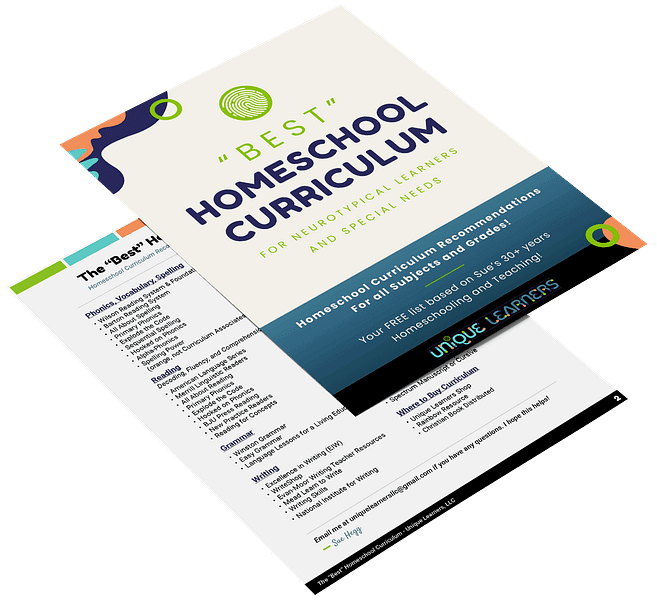
Grab your FREE e-book guide to revamp your homeschool for success!
Are you new to homeschooling, or just wanting a fresh start? Download our FREE “How to Homeschool in 6 Easy Steps” guide and get valuable insights from Sue’s 30+ years of experience as a special educator and homeschool mom of 4!
Want to know about new products and blogs?
Join our email newsletter to be the first to know about a new homeschool and special needs blog, and new products from our shop!
Also, join our Facebook group!
Join our “Homeschool Help for Special Needs” Facebook group! It is a place for homeschool moms to ask questions about homeschooling a child with special learning needs, share teaching and curriculum ideas that have worked (and those that bombed), and be real about the unique challenges of homeschooling with special needs. If you want to join us, be sure to answer the member questions to help us keep this private group secure. Join us now!


