If math word problems regularly end in frustration, tears, or total shutdown, you’re not alone. For many homeschoolers—especially kids with language-based learning differences, working memory challenges, or math anxiety—the hardest part of word problems isn’t the math at all.
It’s the language.
The good news? With a few simple, consistent strategies, you can teach math word problems in a way that feels calm, clear, and doable—for both you and your child.
Start With the Language of Math
Math word problems are really reading comprehension problems in disguise. Before kids can solve them, they need to understand the language of math.
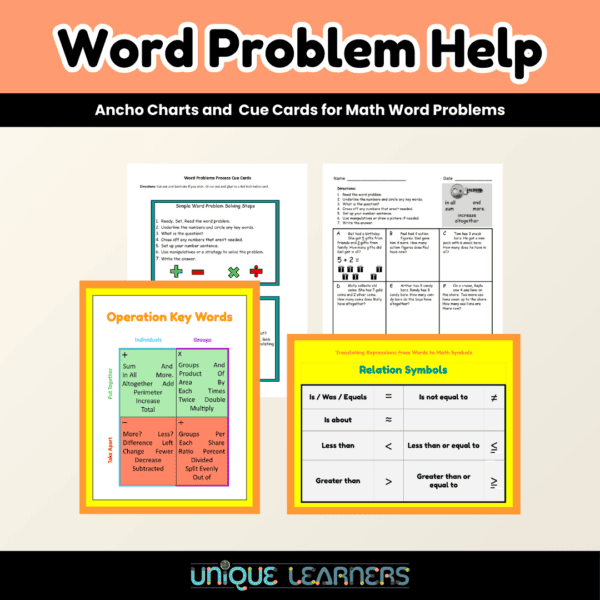
Words like total, each, left, groups, share, and difference act as clues that tell students what kind of thinking the problem requires. When children don’t recognize these clues, they guess—or freeze.
That’s why explicit instruction in math vocabulary is essential, not optional.
Homeschool tip: Treat math vocabulary the same way you treat phonics or grammar. Teach it directly. Review it often. Keep it visible.
Teach a Simple, Repeatable Reading Strategy
Instead of telling kids to “just read the problem,” give them a step-by-step system they can rely on every time.
Here’s a kid-friendly routine that works beautifully:
- Read the problem out loud
(Hearing the language helps with comprehension.) - Underline the numbers
This helps students visually organize information and avoid missing key details. - Circle the clue words
Clue words help identify the operation needed. - Ask: What is this problem asking me to find?
The question sentence matters! - Choose the operation and solve
This structure reduces overwhelm and turns word problems into a predictable process instead of a guessing game.
Use a Clue Word Poster or Cue Cards
Kids should never be expected to memorize math clue words and meanings in isolation—especially early on.
That’s why having visual supports makes such a difference.
✔ A clue word poster near your math space
✔ A small cue card on the desk during lessons
✔ A reference page inside a math binder
These tools give kids confidence and independence.
Good news!
We’ve created a FREE printable set of Unique Learners Math Key Word Anchor Chart and Cue Cards designed specifically for struggling learners.
👉 Download your free Math Word Problem Help here:
Teach the Purpose of Each Operation (Not Just the Procedure)
Many kids can perform math operations—but don’t actually understand why they’re using them. Word problems become much easier when students understand the job of each operation.
Here’s a simple way to explain it:
➕ Addition
- Works with individual things
- Puts things together
- Usually results in a larger number
➖ Subtraction
- Works with individual things
- Takes things apart or compares
- Results in a smaller number
✖ Multiplication
- Works with groups of things
- Puts equal groups together
- Usually gets a much larger number
➗ Division
- Works with groups of things
- Breaks groups apart or shares evenly
- Results in a smaller number per group
When kids understand whether a problem is about things or groups, and whether it’s about combining or breaking apart, choosing the correct operation becomes far less confusing.
Use Single-Operation Word Problems First
One of the biggest mistakes we see is jumping into multi-step word problems too soon.
Instead, start with clean, formatted word problems that use only ONE operation.
✔ One clear question
✔ No extra information
✔ Plenty of spacing
✔ Consistent wording
Let your child practice until they can:
- Identify the operation
- Solve accurately
- Explain why they chose that operation
Independence comes before complexity.
Gently Coach Multi-Step Word Problems
Once single-step problems feel solid, you can move into multi-step problems—slowly and intentionally.
Try this coaching approach:
- Break the problem into parts
Ask: “What happens first?” - Solve one step at a time
Write each step separately. - Circle or box each answer
This helps kids keep track of their work. - Re-read the question
Make sure the final answer actually answers what was asked.
Think of multi-step problems as a sequence of small wins, not one giant task.
Final Encouragement for Homeschool Moms
If your child struggles with math word problems, it doesn’t mean they “aren’t math kids.”
It usually means they need:
- Clear language instruction
- Visual supports
- Predictable strategies
- Time to build confidence
With the right tools, word problems don’t have to end in tears—they can become teachable moments filled with clarity and growth.
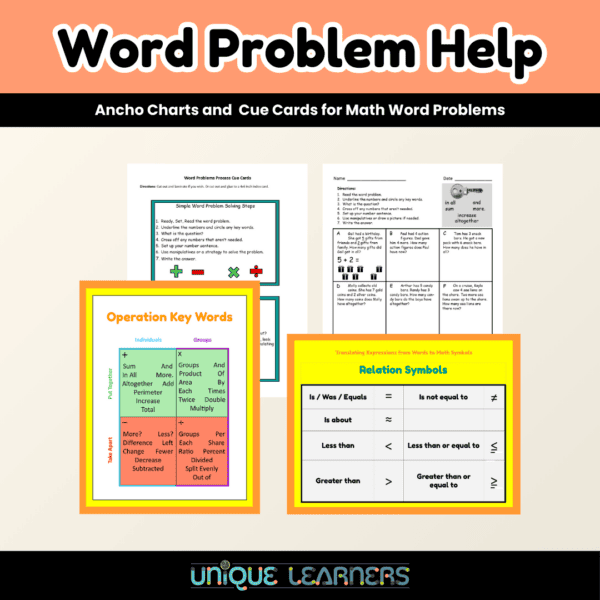
Don’t forget to grab your FREE Unique Learners Math Key Word Anchor Chart and Cue Cards to support your child every step of the way.
You’ve got this—and you’re not alone!