Every child holds a unique key to their own world of imagination, adventure, and knowledge, but for children with dyslexia and autism, finding the right key to unlock reading fluency can feel like an insurmountable challenge. Imagine standing at the threshold of a vast library, where every book holds the promise of discovery, yet the words on the page remain elusive, akin to a jigsaw puzzle with missing pieces. For many parents and educators, the journey to make reading accessible and enjoyable for these children is a heartfelt quest. It’s not just about deciphering words; it’s about empowering young minds to explore realms beyond the confines of their immediate environments. Reading fluency becomes the bridge between a child’s potential and the world of endless possibilities.

In this blog post, we are not merely discussing theories or abstract concepts; instead, we’re diving deep into a treasure trove of practical strategies designed to foster reading fluency in children with dyslexia and autism. From utilizing multisensory approaches that engage every sense to incorporating technology that speaks their language, these methods aim to transform reading from a daunting task into an engaging adventure. Whether you’re a parent eager to unlock new worlds for your child or a tutor striving to tailor your teaching methods to meet the specific needs of your student, this guide will illuminate pathways to success. So get ready to discover innovative, yet simple techniques that underscore the transformative power of tailored reading interventions.
The Importance of Reading Fluency for Children with Dyslexia and Autism
Reading fluency is a crucial skill for all children, but it holds even greater significance for those with dyslexia and autism. For these children, reading fluency serves as a gateway to comprehension, vocabulary development, and overall academic success. It allows them to access information, express their thoughts, and engage in meaningful conversations. However, the journey towards building reading fluency can be challenging for these young minds.
Children with dyslexia often struggle with decoding words accurately and quickly. They may experience difficulties in blending sounds together and developing a sight vocabulary. On the other hand, children with autism may face challenges in understanding social cues or figurative language, which can hinder their comprehension skills. These obstacles make it essential to provide targeted support and interventions that address their unique needs.
By focusing on developing reading fluency in children with dyslexia and autism, we can empower them to unlock their full potential and embrace the joy of reading. In this section, we will explore the fundamentals of reading fluency and discuss strategies that can help break down barriers.
The Fundamentals of Reading Fluency: Breaking Down the Barriers
Reading fluency encompasses several key components that work together harmoniously: accuracy, speed, prosody (expression), and comprehension. Nearly the entire brain is involved in reading fluently! If someone struggles with auditory processing, fluency can be affected. If someone struggles with visual processing, fluency can be affected. If someone struggles with attention, working memory, or any other executive function (frontal lobe), fluency can be affected. Sometimes I wonder how any of us learned to read fluently!

These strategies help to bring the reading process into a streamlined act to build both reading speed and comprehension. Fluent oral reading is also the key for transitioning to silent reading. Kids who are able to decode words effortlessly while maintaining appropriate expression and understanding the meaning behind the text have the prerequisite skills for building fluency.
To build reading fluency in children with dyslexia and autism, it is crucial to focus on two main strategies: repeated reading and guided reading. We can try different techniques within these strategies to help our kids gain confidence and speed.
Two Specific Strategies for Reading Fluency
If you read any part of this blog article, this is the section! The two main strategies for building reading fluency are: repeated reading and guided reading.
Repeated Reading
When young children are first learning to read, we ask them to read the same little story over and over again. But as kids enter second or third grade, we assume they should be able to read a story fluently on the first try. That is seldom the case! Even good readers benefit from repeated reading. When I was a classroom teacher in a high academic school, reading homework was usually to reread the story we had read together in class that day for any grade level. Some kids required more repeated readings to eliminate sounding out most of the words or to eliminate choppy word-by-word reading.
Some parents have said to me, “But aren’t they just memorizing the words then?” YES!! That is the point. We want kids to have enough rehearsal that they can take the first couple of reads through a passage to decode and get the words into their sight vocabulary. After that, we are concentrating on smoothness and expression. Finally, we are aiming toward 100 words per minute that boosts reading comprehension. The process of memorizing is an essential part of reading.
Then parents often ask, “If we want memorization, why do we teach phonics and not just sight words?” The answer to that question is that phonics is the foundation of our English language and the tool we use to decode unfamiliar words. When kids have phonics skills, they can continually tackle more advanced reading passages without needing to drill sight words because they can segment the words and blend the sounds together into the whole word. We want the memorization to take place during the repeated reading phase, so that both phonics and sight vocabulary merge.
How many times should a child repeatedly read a passage? That depends on various factors. But I would say typically two to three times – at least. If a passage is at a child’s independent reading level, twice is likely enough. If a short story is at an instructional level, anywhere from three to ten times may be necessary to help a child read smoothly.
Of course, when you throw in dyslexia or autism, the student will likely fatigue and get bored with a story after the fifth time. That’s when guided reading reading becomes a stronger strategy to use.
Guided Reading
Guided Reading is more multisensory than repeated reading. Guided reading uses a specific protocol that takes advantage of building auditory memory skills and assists with attending to print and tracking.
The process for Guided Reading is as follows:
- Have the student read aloud a fresh, new passage without reading it before. I often take time pointing out the important vocabulary words prior to having the child do their “cold” reading.
- I use curriculum-based measurement (which involves timing) to monitor the progress of my students working on fluency. I never do timing with a stop watch. The pressure on a student with an overt timing mechanism is too stressful for most of my students. I use a second-hand sweep or a silent timer. That way I can select any part of the passage to measure words per minute.
- The reader should make no more than five mistakes when cold reading a one page story. If the child stops to decode many of the words, or makes many mistakes by substituting, missing, or adding any words, you can do more of this process, but do NOT add the timing element.
- Next, have the child listen to the same story at different speeds. You can read the story multiple times or use a recording of the passage. I prefer to have the child track along with their finger or use an index card to follow the lines of print. This is the multisensory part. You are building auditory processing speed (somewhat), auditory memory, attending to print, visual tracking and memory, as well as working memory!
- As you read at least 3 times, start very slowly. The second time, read just a bit faster. The final time, read at a speed that is just slightly faster than your child currently reads. I give the child the choice to hear it more times.
- After listening, have the student do a “hot” reading – timed or not. I have a goal set to pass a story that is set a little above the child’s current reading speed that is reachable after repeatedly listening. You can use the “hot time goal” for passing the story or go by fewer mistakes and smoothness.

If you are homeschooling, you are likely thinking that this process is too much like a therapy and can’t be done in a homeschool setting. I would agree with you for most homeschooling families. The process is time consuming and requires a lot of compliance from the reader. Here are some ideas to do Guided Reading in a homeschool setting:
- Use an easier passage a grade level or two below where your child can read. Do the cold reading, one listening, and the hot reading. If your student makes only a couple of mistakes, move to another story tomorrow.
- You could set up a system that is similar to the early childhood curriculum, Five in a Row. This curriculum focuses on one picture book for a whole week, reading the book each day. To alter this for an older student, select a passage on a topic that is interesting to your child. Do the guided process as you go through the week – just integrate it into your reading instruction time. The passage can be a picture book or an information article. Chapter books are harder to do this process if you plan to stretch a chapter over a whole week.
There is another Guided Reading strategy that is old-fashioned, Choral Reading, also known as Neurological Impress. For this strategy, you read aloud WITH your child. Don’t trade off pages. That helps as a model for smooth reading, but doesn’t usually result in the child reading more fluently. If you use the Choral Reading strategy, sit beside your child so they can hear you read. Officially, the process recommends sitting on the side of your child’s dominant ear. As you both read simultaneously, set the pace just slightly faster than your child currently reads. It takes a few tries for the child to get the hang of going along with you, so be patient and set the pace slower if your child is really lagging.
Creating a Supportive Environment: Building Confidence and Motivation
In addition to targeted strategies like repeated reading and guided reading, creating a supportive environment is crucial for fostering confidence and motivation in children with dyslexia and autism.
One way to achieve this is by incorporating multisensory approaches into reading activities. Engaging multiple senses simultaneously helps reinforce learning connections in the brain. For example, have your students track on the paper with their finger so they have tactile input while they are looking with their eyes and hearing/saying the words.
Additionally, providing a variety of reading materials that cater to different interests and reading levels can foster a love for reading. Don’t worry about placing out picture books, easy readers, short chapter books or longer novels. Kids like to go between books perceived as easy and those that are overly challenging. The variety also eliminates the stigma of being at a specific grade level, which is just an arbitrary leveling anyway. Offer books with interesting characters and themes that resonate with children’s experiences. By creating an inclusive and engaging reading environment, we empower children with dyslexia and autism to embrace the joy of reading.
Individualized Reading Plans: Tailoring Strategies to Unique Needs
Every child with dyslexia and autism has unique strengths, challenges, and learning styles. Therefore, it is essential to develop individualized reading plans that cater to their specific needs.
Another strategy is the use of assistive technology tools that support reading fluency. Text-to-speech software or apps can read aloud text passages while highlighting words on the screen. This helps children follow along as they listen, reinforcing word recognition skills and improving comprehension. Two software apps I like are Google Translate and Speechify. You can scan any passage with your phone or computer and these two programs will read the passage aloud.
You can also incorporate visual supports, such as color-coded text, underlining vocabulary words, or teach visual cues for punctuation can also aid in comprehension for children with dyslexia and autism. These strategies help make connections between words and meanings more explicit.
Harnessing Technology: Tools for Enhancing Reading Skills
Technology has revolutionized the way we approach reading interventions for children with dyslexia and autism. It offers a wide range of tools and resources that can enhance reading skills and provide additional support.
One such tool is speech recognition software, which allows children to dictate their thoughts and ideas instead of relying solely on writing. This can be particularly beneficial for those who struggle with handwriting or spelling difficulties. You can use Google Docs for FREE. In the tools menu, you can find the speech-to-text feature where a microphone pops up, and kids can read or dictate a passage. This can also help with enunciation to see where a kiddo is slurring words together or mispronouncing a word.
Another speech recognition program is called “Clear Fluency.” It is provided alongside the language/reading program, Fast ForWord and requires a certified provider. If you want to learn more about Fast ForWord or Clear Fluency, email us! We would be happy to help you get started at the most reasonable price.
Another strategy is Text-to-Speech software or apps that can read aloud text passages while highlighting words on the screen. This helps children follow along as they listen, reinforcing word recognition skills and improving comprehension. Two software apps I like are Google Translate and Speechify. You can scan any passage with your phone or computer and these two programs will read the passage aloud.
Interactive e-books and digital platforms provide opportunities for engagement through interactive features, animations, and audio support. These elements can capture the attention of children with dyslexia and autism, making reading a more enjoyable experience.
As we continue to develop Unique Learners homeschool curriculum, we will provide audio passages for practicing fluency. Be sure to sign up for our weekly newsletter to get information about our blog topics and the release of new products.
In spite of all the amazing new possibilities of technology in learning, nothing will ever be able to reproduce the comfy setting and undivided attention of a parent listening to a beginning reader practice, The encouragement and praise, as well as modeling of parents who love to read are super powerful teaching methods.
“The best way to learn to read is in the lap of Mom or Dad! – Sue Hegg
Furthermore, educational apps specifically designed to target reading fluency can offer personalized practice sessions, adaptive learning paths, and immediate feedback. These apps often incorporate gamification elements that motivate children to continue practicing their reading skills.
Overcoming Obstacles: Addressing Common Roadblocks in Reading Fluency
While building reading fluency in children with dyslexia and autism, it is essential to address common roadblocks that may hinder their progress.
Vocabulary development plays a crucial role in comprehension. Children with dyslexia or autism may face challenges in acquiring new words or understanding abstract concepts. To overcome this obstacle, educators can incorporate explicit vocabulary instruction by teaching word meanings using visual aids, real-life examples, or semantic maps.
Most kids with dyslexia or autism have difficulty understanding idioms, adages, sequence words, or inferential clues presented in a story.
Another common roadblock is decoding unfamiliar words. Children with dyslexia may struggle with phonemic awareness or blending sounds together. Providing explicit instruction in phonics rules through multisensory activities can help strengthen these foundational skills. Focus on rapid naming (fast decoding) way before working on passage fluency.
For most of our unique learners, we must Incorporate frequent breaks through the day. Keep reading instruction short and focused. Some kids can do a 45 minute to hour lesson; most can’t. Break up the component parts of your reading program. You can do 15 minutes in the morning and 15 minutes in the afternoon. Or do half hour in the morning, and have a quiet reading time right after lunch. Be creative with your routine and space. Make the time and space as inviting as you can. Be joyful. Be hopeful. Many kids who struggle shut down because they’ve lost hope. Celebrating those small gains can make all the difference to keeping your child motivated!
Celebrating Progress: Recognizing Milestones Along the Journey
Building reading fluency is a journey filled with small victories and milestones. It is crucial to celebrate and recognize the progress made by children with dyslexia and autism along the way.
Progress monitoring tools, such as running records or informal reading inventories, can help track improvements in accuracy, speed, and comprehension. These check ups provide valuable insights into a child’s growth and allow for targeted interventions. They also help you to see if your frustration is really based on what is happening with your child’s reading, or if it is just impatience on your part.
I am not a strong “data” person since we used more of a Montessori and Charlotte Mason approach in our homeschool. But you can make anecdotal notes or make a simple graph in your teacher records that will give you information to adjust or change things that aren’t working and ramp up the strategies that are working.
Creating a positive and supportive learning environment where mistakes are viewed as opportunities for growth is essential. Encouraging children to reflect on their progress, set goals, and celebrate their achievements fosters a growth mindset and builds resilience.
Empowering Young Minds: Nurturing Confidence and Love for Reading
Above all else, building reading fluency in children with dyslexia and autism requires nurturing their confidence and fostering a love for reading.
Encouraging independent reading by providing access to books that align with their interests can ignite a passion for reading. Offering choices within appropriate reading levels allows children to explore different genres or topics that captivate their imagination.
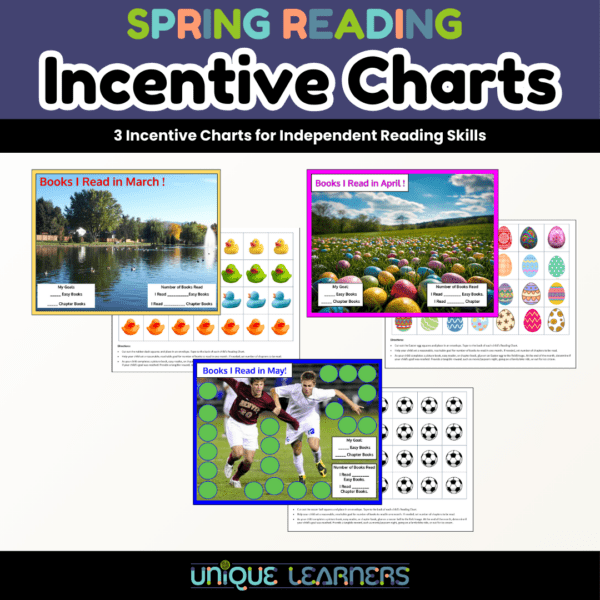
You can grab our seasonal Reading Incentive Charts in the Unique Learners Shop. Click here for the FREE set of Spring Reading Incentive Charts!
Incorporating read-aloud sessions where children can listen to fluent readers model expressive reading can also inspire them to develop their own fluency skills. This can be done through audiobooks or inviting guest readers who bring stories to life through animated storytelling.
Furthermore, creating opportunities for peer interactions such as book clubs or buddy reading programs can enhance social connections while promoting discussion and critical thinking skills.
Conclusion: Embracing the Journey of Building Reading Fluency for Children with Dyslexia and Autism
The journey towards building reading fluency in children with dyslexia and autism may present challenges, but it is a journey filled with hope, resilience, and endless possibilities. By implementing targeted strategies such as repeated reading and guided reading, creating supportive environments, and harnessing the power of technology, we can unlock the potential within these young minds.
Remember, building reading fluency is not a race; it is a personalized adventure that requires patience, understanding, and collaboration between parents, educators, and children themselves. Together, let us embrace this journey and empower children with dyslexia and autism to unlock their full potential through the transformative power of reading fluency.