
Creating a Calm, Structured Homeschool Environment That Supports Focus
Simple, research-informed ways to help your child settle, engage, and learn When the Environment Is the Missing Piece If your child struggles to stay on task, melts down during lessons, or seems constantly distracted, it’s easy to assume the problem is the curriculum. But often, the real issue is the learning space itself. A calm […]
Why Traditional Curriculum Often Fails Neurodivergent Learners
And what homeschool families can do instead When “Good and Beautiful” Curriculum Isn’t Enough If you’ve tried a well-reviewed program and your child is still struggling, it’s easy to wonder what went wrong. You may have been told that The Good and the Beautiful or Abeka are the “best” programs for homeschooling. The truth is, […]
Unlock the Clear Signs Your Child Learns Differently
Have you ever looked at your child and thought, “They’re smart…so why is learning so hard?” If you’re noticing unusual struggles with reading, writing, math, attention, or behavior, you may be seeing early signs your child learns differently. These differences often point to learning brain differences in children, such as dyslexia, ADHD, autism, or FASD. When you begin to understand those differences, you can start teaching struggling learners at home in ways that are far more effective and encouraging.
Understanding the Learning Brain Differences in Children: Dyslexia, ADHD, Autism, and FASD in Simple Terms
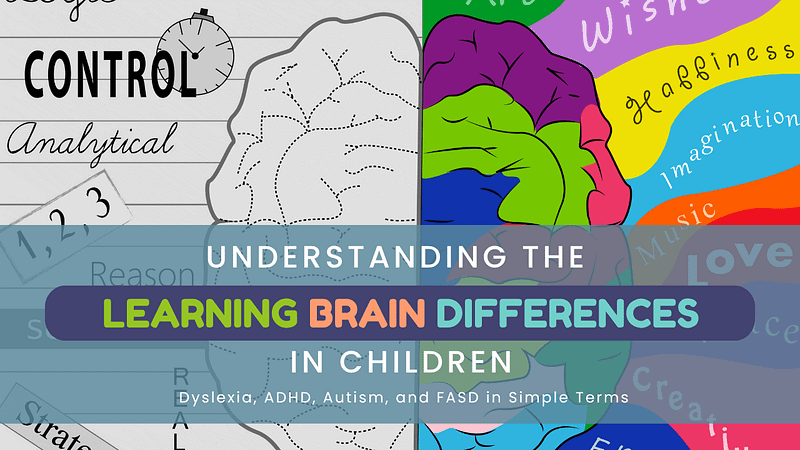
If you’ve ever looked at your child and thought, “They’re smart… so why is this so hard?”—you’re not alone if you don’t understand the learning brain differences in children. Many homeschool moms are teaching bright, capable kids whose brains simply process information differently. When we understand how our children learn, everything begins to shift. Frustration […]
How to Teach Critical Thinking Skills to Build Executive Functions
A K–12 Guide for Homeschool Moms If you have ever found yourself thinking, “My child knows the material, but struggles to think through problems,” you are not alone. Many homeschool moms notice that their children can memorize facts or complete assignments, yet still struggle with problem solving, decision-making, and independent thinking. This is where teaching […]
Teaching Math Word Problems Without Tears
If math word problems regularly end in frustration, tears, or total shutdown, you’re not alone. For many homeschoolers—especially kids with language-based learning differences, working memory challenges, or math anxiety—the hardest part of word problems isn’t the math at all.It’s the language. The good news? With a few simple, consistent strategies, you can teach math word […]
When Life and Homeschooling Intersect: How to Adapt Your Homeschool Without Losing Heart
Homeschooling is beautiful… and real life is, too. Babies are born. Illness hits. Jobs change. Grief shows up. Energy dips. Schedules fall apart. And in those moments, many homeschool moms quietly wonder: “Are we falling behind?”“Am I doing enough?”“Can we even keep homeschooling like this?” Let me gently remind you: 👉 Homeschooling was made for […]
Math Fact Mastery for Kids With Working Memory Weakness
For many kids, math fact mastery isn’t about effort or intelligence—it’s about working memory. When a child has weak working memory, holding numbers in mind, recalling facts quickly, and completing multi-step math tasks can feel overwhelming. The good news? Math facts can be learned and retained—but they need to be taught differently. With visual supports, […]
Teaching Handwriting to Kids with Dysgraphia: What Actually Helps (and What to Let Go)
If handwriting feels like a daily battle for your child, you’re not imagining things. For kids with dysgraphia, writing isn’t just “hard” — it’s neurologically demanding. They’re juggling fine motor control, visual-motor integration, memory for letter forms, spacing, posture, pressure, and speed all at once. That’s a lot. The good news? Handwriting can improve with […]
Color-Coded Grammar for Kids Who Don’t Understand Grammar
(And why it finally makes grammar make sense) If your child can read a sentence but has no idea what a noun or verb actually does—you are not alone. For many kids with language-based learning disabilities (like dyslexia, DLD, ADHD, or ASD), traditional grammar instruction feels abstract, confusing, and frustrating. Grammar books talk about language […]