

Your child knows how to do the math problem—but can’t remember the directions. The reading lesson is sitting on the table—but getting started takes 20 minutes. Your teenager finishes an assignment, but leaves it on the table instead of putting it in a folder. These struggles can be frustrating for both homeschool parents and students. But before assuming that your child is lazy, unmotivated, careless, or simply needs to “try harder,” consider another possibility: executive function skills.

Executive function skills help us manage the mental processes needed to get things done. They allow us to hold information in our minds, control impulses, shift our thinking, make a plan, begin a task, sustain attention, regulate emotions, and keep ourselves organized.
For children with ADHD, dyslexia, autism, learning disabilities, or other neurodivergent learning profiles, weaknesses in one or more of these areas can have a significant impact on learning and how smoothly your homeschool can run. The good news is that a homeschool setting gives parents something extremely valuable: flexibility. Instead of continually expecting a child to perform a skill that is difficult, you can teach the executive function skill explicitly, provide support while it develops, and gradually encourage greater independence.
Executive Function Skills Need to Be Explicitly Taught
One of the most important things for homeschool parents to understand is that executive function skills can be taught. We shouldn’t assume that a child will automatically know how to organize materials, plan an assignment, manage time, control distractions, or work independently simply because they have reached a certain age. You also don’t usually need to pay for an expensive executive function coach because teaching executive function skills can actually become the most fun part of your homeschool.
Think about executive function skills the same way you think about academic skills. Students are not expected to know how to divide fractions just because they are twelve years old. We teach the concept, demonstrate the steps, provide guided practice, and gradually expect the student to complete the skill more independently.
We can use the same approach for executive functioning. To be more effective, show your child how to organize one area rather than telling them, “Be organized.”
Maybe you have a teenager who saves up all assignments until Thursday and doesn’t finish everything. Instead of saying, “You need to manage your time better,” use a weekly schedule planner to block out the teen’s daily activities and discuss WHY doing school work each day is important.
Instead of saying, “Stop procrastinating and get started,” teach a specific starting routine: gather the materials, read the first direction, and complete one small step. You can even coach your child to get started by saying, “On your mark, get set, GO!”
This is how to do explicit instruction for executive function skills: explain the skill, model it, practice it together, provide reminders and visual supports, and gradually reduce those supports as the learner becomes more independent.
Homeschooling gives us an especially good opportunity to do this because executive function instruction can be embedded naturally into everyday learning. Planning a science project can become a lesson in breaking a large task into steps. Cleaning up after math can practice organization. Using a checklist for independent work can develop self-monitoring. Adjusting the day’s schedule can become an opportunity to practice cognitive flexibility.
The goal is not to do everything for the child. The goal is to provide enough support for the child to practice a skill successfully and then gradually transfer responsibility to the learner. With that foundation in mind, let’s look at eight major executive function skills that affect homeschooling and practical ways to teach each one.
Here are eight major executive function skills and practical ways to work on them during your homeschool day.
1. Working Memory: Help Your Child Hold Onto Information
Working memory is the ability to temporarily hold information in the mind while using it. A child uses working memory when solving a multi-step math problem, remembering what a paragraph said long enough to answer a question, following multiple directions, or remembering what they intended to write while forming a sentence.
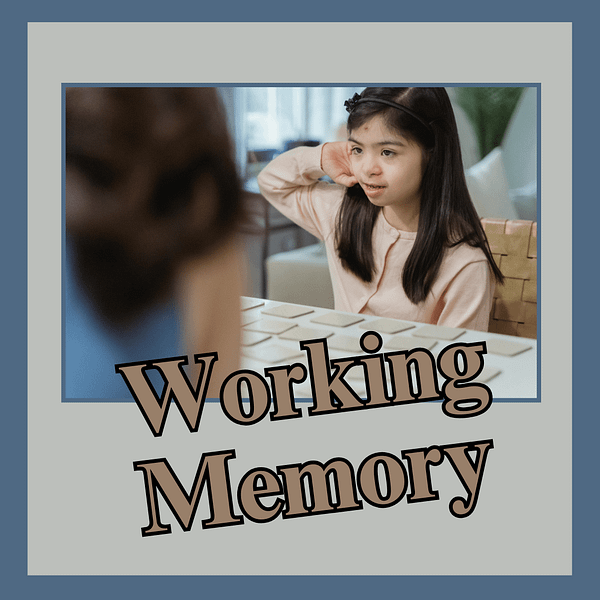
A child with weak working memory may frequently ask, “What am I supposed to do?” This doesn’t necessarily mean the child wasn’t listening. Instead of repeatedly giving the same directions, try reducing how much information your child has to hold mentally. You can also ask your child, “What do you think you are supposed to do?” That gives you an idea of which part of directions are being lost in memory.
Practical homeschool strategies:
- Give one or two directions at a time instead of a long list. You can use coloring pages to turn listening into a game.
- Write important directions on a whiteboard.
- Let your child jot down three keywords before beginning an assignment.
- Break copywork into short phrases instead of expecting a child to copy an entire paragraph.
- Use pictures, checklists, manipulatives, and other visual reminders.
- Have your child repeat a direction back in their own words before beginning.
- Play games that build working memory, like checkers, Goblet, or even Go Fish.
You can also practice working memory informally. Play Simon Says with multiple directions or play silly games that build onto each person’s responses. Gradually increase the complexity as your child becomes successful.
The goal isn’t to make school into a memory test. Just do the activities as brain breaks or even as a reward! External supports can reduce the cognitive load so your child can concentrate on the skill you are actually teaching.
2. Impulse Control: Practice the Pause
Impulse Control, sometimes called inhibitory control, is the ability to stop, pause, and think before responding.
In a homeschool setting, impulse control may manifest like: not wait for directions, interrupting off-topic during read aloud time, not ignoring a sound or visual distraction, grabbing supplies belonging to a sibling, checking over work before declaring it finished, or not stopping one activity when it is time to move to another. Rather than constantly saying, “Slow down!” or “Think before you act,” teach what that process actually looks like.
Practical homeschool strategies:
- Use a visual reminder that says Stop – Think – Choose.
- Play games such as Red Light, Green Light.
- Before answering a difficult question, establish a five-second “think time.”
- Teach your child to stop and check an assignment before turning it in, then ask as a reminder.
- Practice identifying distractions and decide together what to do about them.
- For older students, talk through real situations: “You want to start playing your game, but math isn’t finished. What are your choices?”
These strategies turn impulse control into a problem-solving skill instead of a discipline issue.
3. Flexible Thinking: Teach Your Child How to Make a Plan B
Some learners become overwhelmed when the expected plan changes. Others know one way to solve a problem but have difficulty trying another approach. Cognitive flexibility is the ability to shift attention, adjust to changes, and consider different ways of thinking about a problem.
Homeschooling provides countless opportunities to practice flexibility in a safe environment.
Here are some practical homeschool strategies:
Try solving the same math problem with manipulatives, a drawing, a number line, and a written equation. Ask: “Can we find another way to get the same answer?”
You can also deliberately practice small changes in familiar routines. Occasionally change the order of two subjects, use a different place for reading, or change a familiar game rule.
When an unexpected change occurs, give it a name: “Our first plan isn’t going to work. Let’s make a Plan B or Plan Bubbles.”
For children who find change particularly difficult, don’t introduce surprises just for the sake of practicing flexibility. Give advance notice of about 5 minutes for little changes and 30 minutes for big activity changes. Use visual schedules when possible. The objective is to build flexibility without creating unnecessary emotional stress.
4. Planning and Prioritizing: Make the Invisible Steps Visible
“Finish your history project by Friday” sounds like one assignment to most adults. To a student with weak planning skills, however, it may be an enormous, undefined task.
Planning requires the learner to picture the finished product, identify the individual steps, determine what materials are needed, estimate how much time each part will take, and decide what should happen first. That’s a lot of executive functioning.
Practical homeschool strategies:
Take a larger assignment and work backward from the due date. It’s even better if you collaborate with your teen to come up with the break down. If a project is due Friday:
Friday: Present the finished project.
Thursday: Make corrections and finish the display.
Wednesday: Write the information.
Tuesday: Gather facts and pictures.
Monday: Choose the topic and gather materials.
For daily planning, keep priorities simple. Have your child identify a Top Two—the two tasks that are most important to complete that day. Older students can gradually take greater responsibility for estimating time and breaking projects into steps.
Harvard’s Center on the Developing Child notes that adults play an important role in scaffolding executive function development—helping children manage challenging tasks and gradually stepping back as they become more capable.
5. Task Initiation: Make Starting Easier
Sometimes a child understands an assignment and is capable of completing it—but still can’t seem to start. Task initiation is an executive function where many kids with ADHD or other issues may get stuck. It can look like procrastination, avoidance, wandering around looking for supplies, sharpening a pencil three times, or suddenly remembering seventeen unrelated things that need to happen first. Instead of repeating, “Just get started,” make the starting point concrete.
Practical homeschool strategies:
This may seem obvious, but the “Ready, Set, Go!” strategy is the easiest and often the best in getting a child over the hurdle of starting a task. Be sure the directions and expectations are clear. Then say, “OK. You can start. I’ll watch you.” You can even say, “Go.”
Reduce a large task to the first tiny action. You may say: “Go write your paragraph.” Instead, try: “Open your notebook and write the date.” Then: “Good. Now write the topic sentence.”
A short timer might help. For some kids, a timer that clicks or makes a humming noise can help give a sense of urgency, while others get overly stressed with a noise. Try working for five minutes rather than focusing on completing the entire assignment. You may also vary the amount of time and give a point or tally mark if your child is actively working.
Some children benefit from having a parent nearby while they begin. You might work quietly on your own task while your child starts theirs and then move away once the child is engaged. The support isn’t meant to last forever. Think of it as a temporary scaffold: support the start, practice the routine, and gradually remove your help.
6. Sustained Attention: Adjust the Amount of Work to the Learner
Attention isn’t simply a matter of willingness. A child may concentrate intensely on building LEGO creations for an hour but struggle to remain focused on handwriting for ten minutes. The cognitive demands of those activities are completely different. For homeschoolers with ADHD or other executive function challenges, expecting longer work periods doesn’t necessarily develop better attention. Instead, begin where your child can be successful.
Practical homeschool strategies:
- Break lessons into short work periods.
- Alternate demanding tasks with easier ones.
- Schedule movement between subjects.
- Remove unnecessary visual and auditory distractions.
- Reduce the number of problems on a page when the skill has already been demonstrated.
- Use a timer so the work period has a visible ending.
- Allow appropriate fidgets or movement when they improve—not interfere with—attention.
An eight-minute period of productive math practice may accomplish far more than 30 minutes spent repeatedly redirecting an overwhelmed child. As attention improves, gradually extend the work period.
Build stamina from success rather than frustration.
7. Emotional Regulation: Recognize When Learning Has Become Too Hard
Executive function also affects the ability to manage frustration and emotions. This becomes especially important for children with learning disabilities who may encounter difficult tasks throughout the homeschool day.
A learner with dyslexia may become frustrated during reading. A child with ADHD may become overwhelmed by a lengthy worksheet. An autistic learner may have difficulty transitioning unexpectedly from one activity to another. Sometimes, doing the hardest task first can help reduce avoidance and have it followed by more fun activities. You may want to “sandwich” the hardest tasks between two more motivating activities. For some learners, doing the hardest task last can allow for resting after school work will be done.
When emotions escalate, simply demanding more effort rarely solves the underlying problem. Emotional regulation is built from recognizing the Thoughts, Feelings, Actions cycle. Explicit instruction in analyzing self-talk, naming feelings, and discussing the why behind behavior or emotional outbursts can help you to adjust your routine and work on emotional regulation goals.
Practical homeschool strategies:
Teach your child to recognize early signs of frustration.
You might use a simple 1–5 scale:
1 – Calm
2 – A little uncomfortable
3 – Frustrated
4 – Very upset
5 – Need a break
Then decide ahead of time what strategies are available: getting a drink, taking a movement break, sitting somewhere quiet, asking for help, or reducing the task into a smaller step.
Parents can also model productive self-talk: “This isn’t working the way I expected. I’m going to stop and figure out another way.” Emotional regulation isn’t about eliminating feelings. It’s about gradually learning what to do with them.
8. Organization: Create Systems Your Child Can Actually Maintain
Organization involves much more than having attractive bins with labels and color-coded folders.
The real executive function skill is being able to use an organizational system consistently. If your child constantly loses pencils, forgets where completed assignments belong, or leaves books throughout the house, start by simplifying the environment. You may think your organizational system is apparent to your children so they can access supplies and return them the same way you had them, but more often, kids are clueless about a system that someone else has put together. However, as your student gets older (5th grade and up), you can coach your tween or teen to organize their own supplies. Start by doing it together.
Organizational skills also impact time management, structuring paragraphs or stories in writing, knowing the order of operations in math, sorting and putting away laundry, putting shoes or dishes away in the right place, and so many other daily household tasks.
Practical homeschool strategies:
Create obvious places for frequently used materials.
For example:
- one bin for math materials
- one crate for each child’s work
- task boxes from left to right
- one location for pencils and supplies
- one folder or tray for completed work
- one designated charging spot for devices
Color coding subjects can also help: perhaps blue for math, green for reading, and orange for science. OR assign a color for each kid based on their favorite colors. That way, kids with organizational difficulties can easily locate their own folders or bins.
CHADD recommends helping children develop systems that make normally invisible planning processes more visible. A checklist, labeled folder, visual schedule, or clearly marked storage area can reduce the amount of information a child must remember independently.
At the end of the morning and again in the afternoon, spend five minutes resetting the learning space together – everyone helps.
Most importantly, involve your child in creating the system.
Don’t Expect Independence Before You’ve Taught the System
One of the biggest mistakes we can make with executive function skills for kids is assuming that children should automatically know how to organize themselves because of their age.
We wouldn’t hand a child a multiplication worksheet without first teaching multiplication. Yet we sometimes tell that same child, “Get organized.” “Manage your time.” “Pay attention.” “Stop procrastinating.” “Remember your work.”
Organizing is not a single behavior. It involves complex skills. Teach the system before expecting independence. You are the best person to teach organization since the whole family lives under the way you have organized your home. If you struggle with organizational skills, you are not alone! Join our Facebook group , Homeschool Help for Special Needs, or email us. We are always happy to assist homeschool moms in finding the specific strategies that will work for YOU and your student!
Show your child how to break down an assignment. Create the checklist together. Model how you decide what comes first. Practice resetting the workspace. Help your child recognize when attention is fading. Then gradually reduce your involvement.
Executive Function and the Three Levels of Learning
Executive function demands can also change depending on whether your child is working at the independent, instructional, or frustration level.
At the independent level, the academic skill is easy enough that your child can complete it with little help. This is a good time to practice greater independence with planning, organization, and task completion.
At the instructional level, the academic material is newer and requires explanation, modeling, prompting, or coaching. Because more mental energy is being used to learn the academic skill, your child may need additional executive function support.
At the frustration level, the academic demand is too difficult to complete without intensive help. Increasing expectations for attention, independence, organization, or persistence at this point can add even more cognitive load.
This distinction is particularly important when homeschooling children with learning disabilities because performance can be inconsistent. A child might independently complete one type of math problem but need significant support when a new concept is introduced. Adjust the executive function demands along with the academic demands.
A Better Question for Difficult Homeschool Days
When your homeschool day starts unraveling, try changing the question. Instead of asking: “Why won’t my child do this?”
ask: “Which skill is making this task difficult?”
- Is the child forgetting the directions?
- Unable to get started?
- Distracted?
- Overwhelmed by too many steps?
- Having difficulty shifting from the previous activity?
- Frustrated because the academic task itself is too difficult?
Once you have identified what skill is getting in the way, we can move away from correcting behavior and lean toward identifying the support the learner actually needs.
Executive function skills develop gradually, and different children develop them at different rates. Harvard’s Center on the Developing Child describes executive function development as a process that continues into early adulthood and is strengthened through experience, practice, and appropriate adult support.
That’s one reason homeschooling can offer such a valuable environment for neurodivergent learners. We can slow down, teach a missing skill explicitly, provide visual and multisensory supports, adjust the cognitive load, and give children opportunities to practice until the system becomes more independent.
The goal isn’t a perfectly organized homeschooler. The goal is to help your child understand how their brain learns, which supports help them succeed, and how to gradually use those tools for themselves.
References and Further Reading
Harvard University Center on the Developing Child — Executive Function
A collection of research-based resources explaining executive function, self-regulation, and how these abilities develop throughout childhood.
Center on the Developing Child: Executive Function
Harvard University Center on the Developing Child — Activities Guide: Enhancing and Practicing Executive Function Skills
Includes age-appropriate ideas for helping children and adolescents practice working memory, inhibitory control, cognitive flexibility, planning, and related skills.
Enhancing and Practicing Executive Function Skills
CHADD — Executive Function Skills
An overview of executive function and its relationship to ADHD, including working memory, self-regulation, planning, organization, attention, and task initiation.
CHADD: Executive Function Skills
CHADD — Executive Functioning Support for Kids with ADHD
Practical information about helping children make planning and organizational processes more visible through checklists, routines, labels, and other supports.
Executive Functioning Support for Kids with ADHD
Grab your FREE e-book guide to revamp your homeschool for success!
Are you new to homeschooling, or just wanting a fresh start? Download our FREE “How to Homeschool in 6 Easy Steps” guide and get valuable insights from Sue’s 30+ years of experience as a special educator and homeschool mom of 4!
Want to know about new products and blogs?
Join our email newsletter to be the first to know about a new homeschool and special needs blog, and new products from our shop! Sign up for only the newsletter, or grab your FREE “How to Homeschool in 6 Easy Steps” guide and you will also be added to the newsletter!
Also, join our Facebook group!
Join our “Homeschool Help for Special Needs” Facebook group! It is a place for homeschool moms to ask questions about homeschooling a child with special learning needs, share teaching and curriculum ideas that have worked (and those that bombed), and be real about the unique challenges of homeschooling with special needs. If you want to join us, be sure to answer the member questions to help us keep this private group secure. Join us now!


