
Phonemic awareness—the ability to hear, identify, and manipulate individual sounds (phonemes) in spoken words—is one of the most critical foundational skills in learning to read. Most children develop a sense of sounds in words and syntax of sentence structure as they learn to speak. For students with dyslexia and other reading disabilities, lack of phonemic awareness is a clue that reading and spelling is likely to be difficult. Phonemic awareness is essential to developing the sense of the structure of language from the foundational components of sounds to how words are created from sounds, as well as the similarities and differences in words. Understanding this connection can empower educators, parents, and caregivers to provide the kind of support that truly transforms reading outcomes.
Why Phonemic Awareness Matters
Reading is a complex cognitive process that begins with oral language and progresses to translating written symbols into sounds. At the heart of decoding lies phonemic awareness. When children can distinguish and manipulate sounds in words, they are better equipped to match those sounds to letters and letter patterns, a key component of fluent reading.
For students with dyslexia, who typically struggle with decoding and word recognition, weak phonemic awareness is often a root cause in difficulties in learning written language, both to decode (reading) and to encode (spelling and writing). Without this ability, reading becomes a frustrating and inconsistent process. Fortunately, research consistently shows that explicit instruction in phonemic awareness can significantly improve reading skills for children with dyslexia and related learning challenges.
Categories of Phonemic Awareness
Phonemic awareness is not a single skill but a set of interrelated abilities. Some of the most important categories include:
-
- Phoneme Isolation: Recognizing the individual sounds represented by letters. This also translates to a child being able to recognize that letters represent the sounds we speak.
Example: What is the sound of the letter m? /m/
- Phoneme Isolation: Recognizing the individual sounds represented by letters. This also translates to a child being able to recognize that letters represent the sounds we speak.
-
- Phoneme Identity: Identifying the same sound in different words.
Example: What sound is the same in “dog,” “dig,” and “duck”? /d/
- Phoneme Identity: Identifying the same sound in different words.
-
- Phoneme Categorization: Recognizing the word with the odd sound in a group.
Example: Which word doesn’t belong: “bat,” “ball,” “sun”? (sun)
- Phoneme Categorization: Recognizing the word with the odd sound in a group.
-
- Phoneme Blending: Combining a sequence of spoken sounds to form a word.
Example: What word is /s/ /k/ /u/ /l/? (“school”)
- Phoneme Blending: Combining a sequence of spoken sounds to form a word.
-
- Phoneme Segmentation: Breaking a word into its component sounds.
Example: What sounds are in “ship”? /sh/ /i/ /p/
- Phoneme Segmentation: Breaking a word into its component sounds.
-
- Phoneme Deletion and Substitution: Removing or replacing sounds to form new words.
Example: What word do you get if you take the /r/ out of “frog”? (“fog”)
- Phoneme Deletion and Substitution: Removing or replacing sounds to form new words.
Each of these skills builds upon the others and contributes to a student’s ability to decode words, a crucial step in reading fluency. Phonemic Awareness skills also help children to understand the literal and figurative meanings of language, which in turn assists in the development of listening comprehension and, ultimately, reading comprehension.
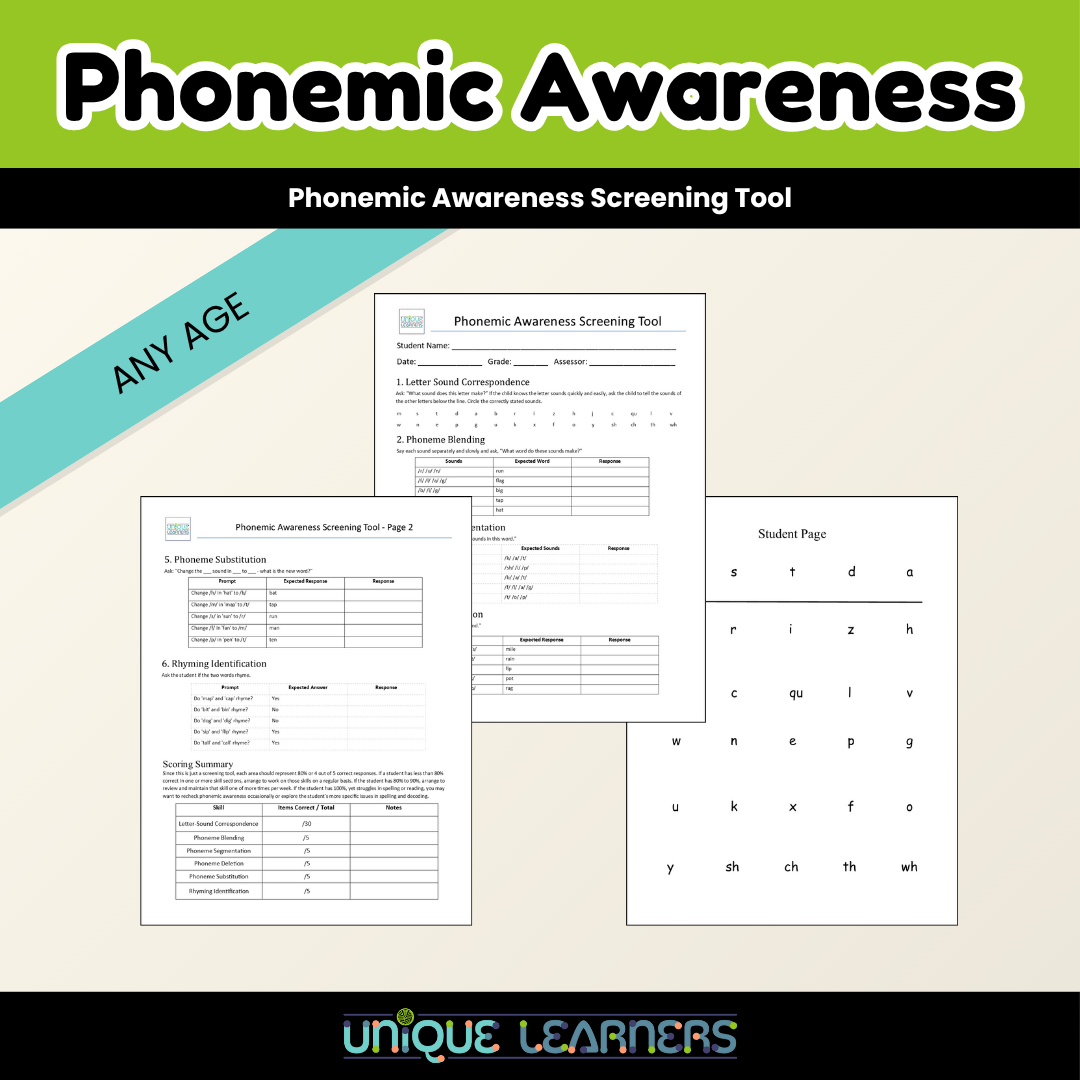
If your child is struggling in learning to read and/or spell words, you may want to do a quick screening for phonemic awareness skills. You can grab our FREE Phonemic Awareness Screening Tool here. If you find that your child is able to answer the screening questions easily, your child may have some other issues in learning to read or spell. The screening tool helps you to know what to look for in phonemic awareness. If you find your child struggles in any of the skills sections, you are welcome to message us to learn more about how you can assist your child in any part of the process of learning to read. We are always happy to help homeschool parents in teaching their children!
How Phonemic Awareness Helps Reading
-
- Improves Decoding Skills: When students understand how sounds map to letters, they can sound out new words more effectively.
- Boosts Reading Fluency: Fluent readers can read with speed, accuracy, and expression. Phonemic awareness lays the groundwork for this by ensuring students can recognize and process word parts quickly.
- Enhances Spelling Ability: Students who can segment and manipulate sounds are better at spelling, because they understand how words are constructed at a phonological level.
- Supports Vocabulary Growth: Once decoding becomes automatic, students can focus more on understanding and learning new words.
- Builds Reading Confidence: As reading becomes less of a struggle, students develop a more positive relationship with reading, which encourages practice and continued growth.
Practical Implications for Educators and Parents
-
- Early Screening: Identifying phonemic awareness deficits early allows for timely intervention, often before significant reading problems develop.
-
- Explicit Instruction: Teaching phonemic awareness should be intentional, structured, and multi-sensory—especially for students with dyslexia.
-
- Use of Intervention Programs: Evidence-based programs like Orton-Gillingham and Wilson Reading System incorporate phonemic awareness training as a core component.
-
- Integrating with Phonics: Phonemic awareness is an oral skill, but it must be connected with phonics instruction (linking sounds to letters) to support reading. Instruction of phonemic awareness is sometimes taught prior to beginning phonics instruction; however, it is important to realize that continued practice in phonemic awareness integrated with on-going phonics instruction to demonstrate the connections between spoken words and written words, strengthen word analysis skills, and continue to build both spoken and reading vocabulary.
Conclusion
Phonemic awareness is the gateway to proficient reading. For children with dyslexia and other reading disabilities, mastering this foundational skill can mean the difference between lifelong struggles and successful literacy. By recognizing the role of phonemic awareness and providing targeted support, we open the door to greater academic achievement and a brighter future.
Further Reading:
-
- National Reading Panel (2000): Teaching Children to Read
-
- Shaywitz, S. (2003): Overcoming Dyslexia
-
- Moats, L. (2010): Speech to Print: Language Essentials for Teacher


